Skip navigation
Go to home page > News > Our blog > Following in the footsteps of giant tortoises
Galapagos giant tortoise
24/07/2026 Island restoration Women in science

Following in the footsteps of giant tortoises

Why do giant tortoises migrate? We spoke to Courtney Pike at the Charles Darwin Foundation about her work to understand and protect the ancient tortoise highways of Galapagos.

Hannah Rickets

Communications and Education Officer

Galapagos giant tortoises embark on seasonal migrations between the humid highlands and arid lowlands. But these routes aren’t random, they are caved out over many years, making them vital for tortoise conservation.

We spoke to Courtney Pike, senior researcher at the Charles Darwin Foundation and leader of the Galapagos Tortoise Movement Ecology Programme, about their work, partly funded by GCT, to learn everything there is to know about the movements of these gentle giants.

Courtney Pike with giant tortoises © Charles Darwin Foundation

Why do tortoises need to migrate?

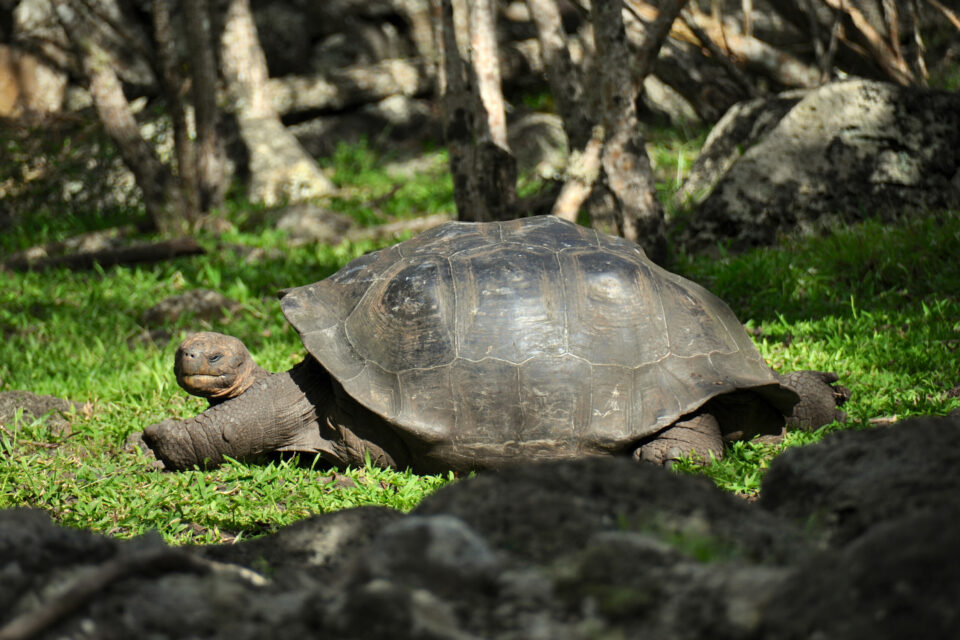
Well, actually, not all giant tortoises migrate – but those that do generally migrate to access seasonal food resources. As vegetation in the arid lowlands becomes less abundant during the drier season, many giant tortoises move up to the highlands, where vegetation remains available to forage all year round.

The return of heavy rains during the wet season promotes the growth of more nutritious vegetation in the lowlands, so many migrating tortoises return to forage on this new growth. Additionally, reproductive females that migrate to the highlands to forage then return to the arid lowlands to lay their eggs.

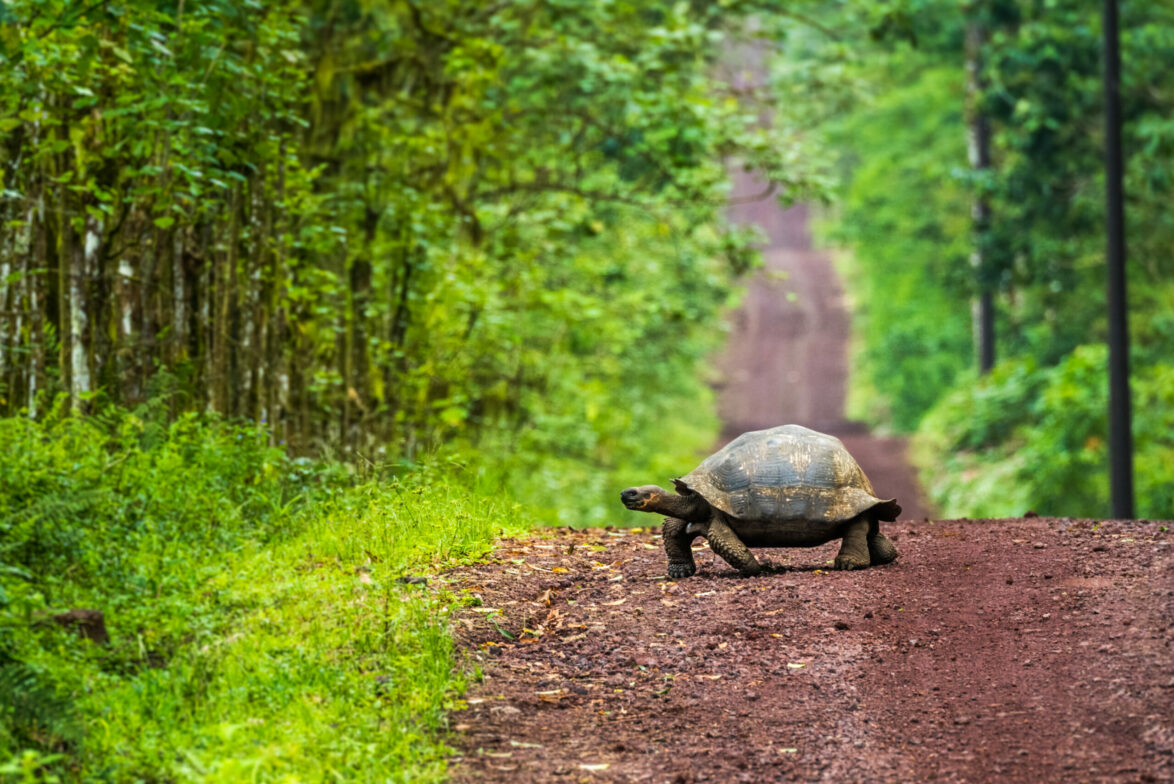
Galapagos giant tortoise crossing dirt road, Santa Cruz
A Galapagos giant tortoise © Nick Dale
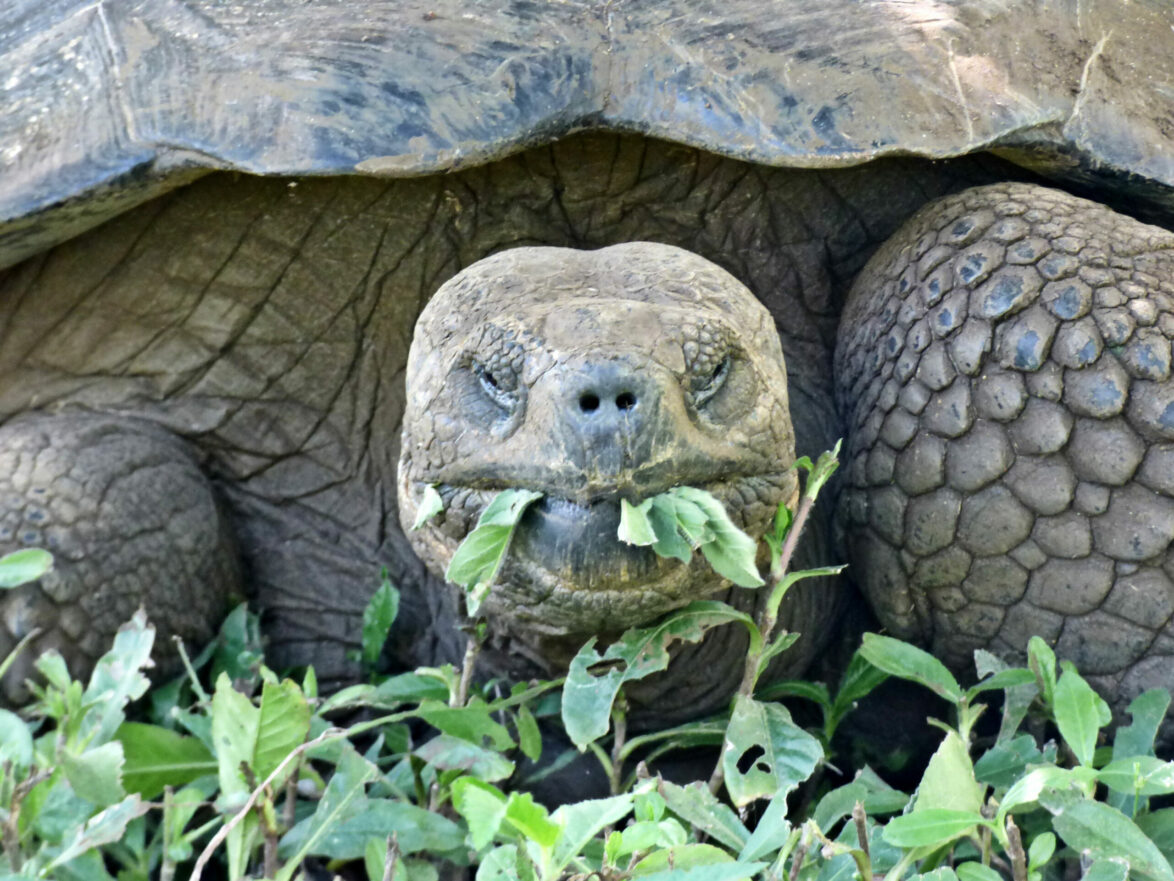
Galapagos giant tortoise eating fruit

Protecting giant tortoises

For over a decade we have been supporting work to map the migration routes of Galapagos giant tortoises.

Discover more

How do tortoises establish their migration routes?

That is one of the biggest questions that we are still trying to answer. Based on our studies, we know that tortoises move between the highlands and lowlands for food resources. However, we still don’t know how each individual first establishes their migratory route. For example, it is unclear if females that hatched at one nesting site return to that same site once they reach reproductive age, more than 20 years later.

Giant tortoises have most likely been migrating for thousands of years in Galapagos. Once their migratory routes are established, they may use spatial memory to retrace similar routes each year. Their migratory patterns are also shaped by climate, food availability, and the presence of open pathways or less dense vegetation that they can move through.

Galapagos giant tortoise
A giant tortoise feeding © Peter Lewis

Why is it important to tag and track giant tortoises as they migrate across the Islands?

Long-term tracking of giant tortoises in Galapagos allows us to better understand their movements and migratory patterns. These data also help us identify potential threats to tortoises’ migratory routes and their overall health. Disturbances to their habitats on inhabited islands can disrupt their migratory routes due to fences, invasive plants, roads, and changes in land use.

Continued monitoring of their movements also helps us understand how giant tortoises are responding to climate change. Together, these data help guide conservation and management actions that protect giant tortoises’ migration routes, habitats, and health.

The GTMEP team tagging a giant tortoise_CDF
Courtney taking measurements of a giant tortoise © Charles Darwin Foundation

Learn more about tortoises

We have lots of free educational materials all about the giant tortoises of Galapagos!

Learn more

What are some of the risks pollution, including plastic pollution, poses for giant tortoises along their migration routes?

Giant tortoises can be exposed to a wide range of pollutants along their migration routes, from chemical contaminants to trash and plastic waste in areas with greater human activity. As they have not evolved in environments with human-made waste, some individuals may ingest trash and plastic debris they encounter in their habitat.

Our research group has recently documented plastic ingestion by giant tortoises on Santa Cruz island, showing that this already takes place in shared landscapes. Although the effects of pollution and plastic ingestion on giant tortoise health are still being studied, plastic ingestion may cause digestive problems, increase exposure to chemicals associated with plastics, negatively affect overall health, and, in severe cases, lead to death. These findings highlight why reducing pollution, including plastic waste, along giant tortoise migration routes is important for protecting the health of giant tortoises and other wildlife that share their habitats.

A tagged giant tortoise_CDF
A tagged giant tortoise © Charles Darwin Foundation

Why is it important for local communities to play a leading role in helping to protect tortoise migration routes from pollution?

Local communities have a shared responsibility to help protect the environment in which they live and the unique wildlife of Galapagos, including giant tortoises. While much of Galapagos is protected, tortoises also migrate through agricultural and privately owned land, and some of their migration routes overlap with human activities in highly populated areas. Therefore, local communities play a central role in protecting tortoise migration routes from pollution. Management of trash, plastic waste, and other pollutants is key to protecting the health of giant tortoises, other native and endemic wildlife, and people who live in Galapagos.


Plastic clean-up in Galapagos
A plastic clean up by the local community © Frente Insular
Plastic waste found in Galapagos giant tortoise faeces

Tortoises are ingesting plastic

A study published in the journal Environmental Pollution has found that giant tortoises on Santa Cruz island are ingesting items including medical face masks, glass and plastic bags.

Read more

Adopt a Galapagos tortoise

Adopt a Galapagos giant tortoise today and help to protect this species, their habitats and other Galapagos wildlife.

Related articles

Galapagos land iguana (Baltra)
4th Mar 2026
Events Rewilding

Rewilding Islands Webinar 2026

At our webinar on 3 March, Dr Luis Ortiz-Catedral gave a fascinating insight into the efforts to reintroduce species including the Floreana mockingbird, Floreana racer snake and Galapagos land iguana.
Read more
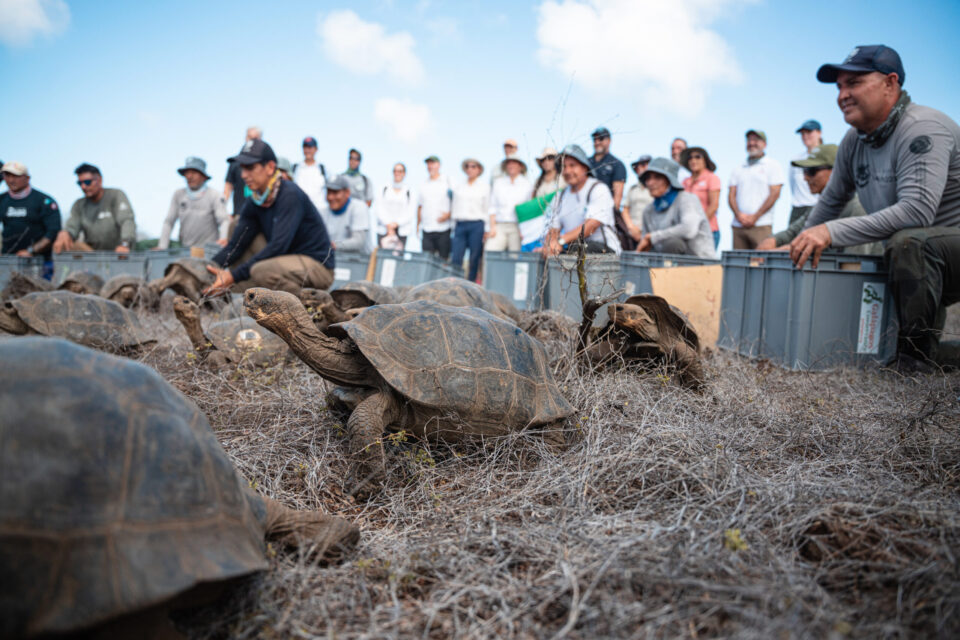
Floreana giant tortoises are released back onto the island, February 2026
20th Feb 2026
Island restoration Rewilding

Giant tortoises return to Floreana

158 giant tortoises have been reintroduced to Floreana, a huge milestone in the restoration of the island, following decades of preparation supported by GCT and many others.
Read more
Rábida leaf-toed gecko
16th Jan 2026
Invasive species Island restoration

Bouncing back: Inspiring stories of nature recovery in Galapagos

A growing body of evidence shows that, by giving struggling species a helping hand, we can kickstart natural processes that lead to a rapid and remarkable recovery.
Read more
Floreana giant tortoise
12th Jan 2026
Island restoration Rewilding

The return of the Floreana giant tortoise

The remarkable story of the Floreana giant tortoise, a species that the world thought was lost forever.
Read more

Get the latest news from Galapagos

Join our mailing list to receive our monthly email newsletter, bringing you the latest news on Galapagos and our work to protect the Islands.

This field is hidden when viewing the form
Share This Page