Skip navigation
Go to home page > News > Our blog > Galapagos photography tips from the experts
Flamingos on Floreana
15/09/2025 Tourism

Galapagos photography tips from the experts

We asked photographers Jonathan Green, Maya Arkane and Amit Misra for their top Galapagos photography tips, from selecting the right kit to finding a fresh angle.

Tom O'Hara

Communications Manager

The Galapagos Islands are a dream destination for photographers. The otherworldly lava fields, mist-wreathed highlands and nutrient-rich seas are home to an incredible cast of characters, both animal and human. The wildlife here is so abundant, so tame and unafraid of people.

But photography in Galapagos is not without its challenges. The weather can swing from bright equatorial sun to gloomy grey skies and sudden downpours; boat rides can be bumpy, and underwater photography is hard to master; and every day here is so varied, so packed full of once-in-a-lifetime experiences and amazing sights, that it’s easy to spend too much time taking photos and forgetting to just take it all in.

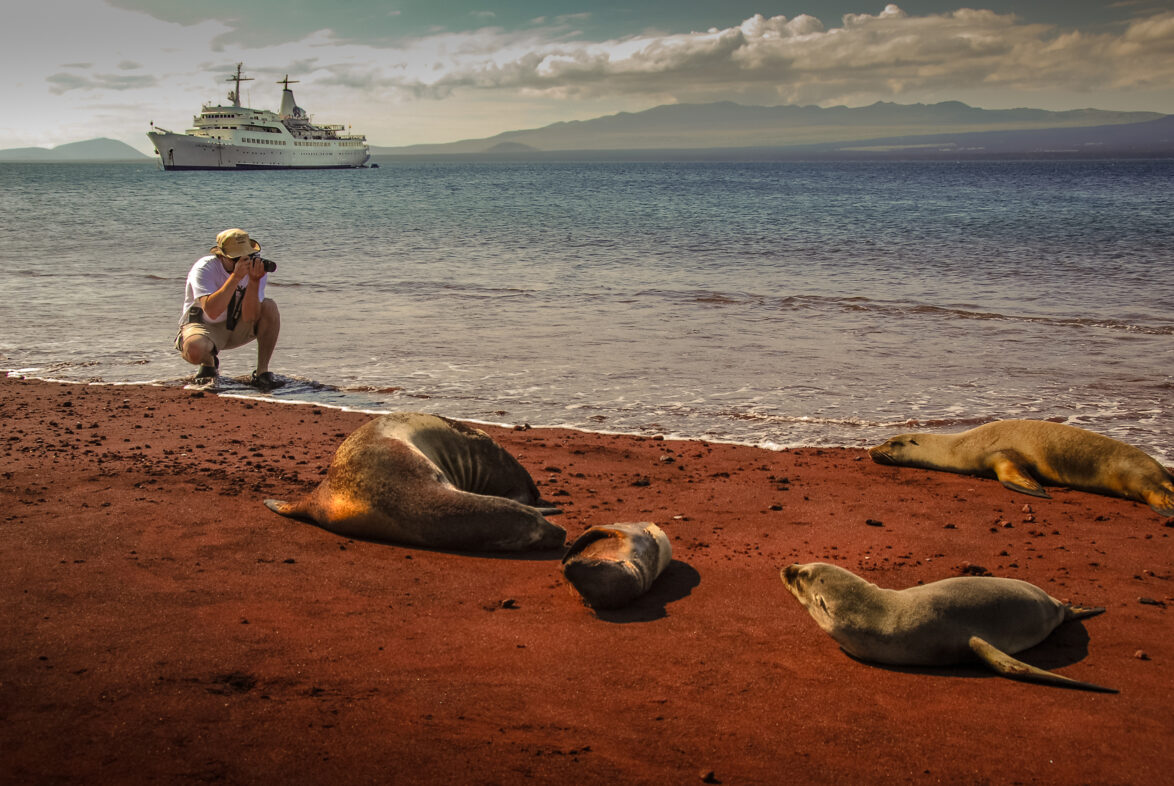
Tourist photographing sea lions on Rabida island, Galapagos
Tourist photographing sea lions on Rabida © Jerry Chinn

To help you get the most out of your trip to Galapagos, we asked three different photographers for their advice and insider tips…

...every day here is so varied, so packed full of once-in-a-lifetime experiences and amazing sights, that it’s easy to spend too much time taking photos and forgetting to just take it all in.

Sofía Green, Jonathan Green & Dr Jen Jones at Craghoppers HQ

Jonathan Green

Jonathan is co-founder and director of the Galapagos Whale Shark Project, as well as a keen wildlife photographer, qualified naturalist guide and dive master, who has been working in Galapagos for more than 25 years.

So much of the amazing wildlife in Galapagos is under the waves – do you have any tips for those who aren’t experienced in underwater photography?

Underwater photography is more challenging than on land, but the secret is usually in getting two things right: light and proximity to subject. If you don’t have experience with a full underwater rig – a DSLR in a housing, strobes and extension arms etc – Galapagos is not the place to learn.

Keep it simple – there are a number of underwater camera setups using your smartphone in a waterproof housing, which can do both photos and video. Do test the housing or pouch first without the phone inside it, as this could be an expensive experience if the waterproofing isn’t working. Also check the depth limitations on the product!

I recently changed from GoPro to DJI Osmo 5 Pro for easy underwater videos. There are a couple of online tutorials that can help with settings and I find the quality far superior to GoPro. Very important and a rule of thumb: never shoot looking down, try to shoot the subject on the same level or, even better, from below the subject, and never from further away than two metres (six feet), unless it is a whale!

Often close to the beach there are fantastic conditions for snorkelling and underwater photography or videography of sea lions, turtles, rays, sharks and schools of fish.

A whale shark in Galapagos, which plays an important role in blue carbon capture
Whale shark with fish and diver © Jonathan Green

What are some common mistakes to avoid when photographing in Galapagos?

Just because you have a digital camera, does not mean that you should fire at will with machine gun rapidity. Firstly you will have far too many images to try to process or choose from, and secondly the composition will be completely absent. I advise photographers of all levels to decide what their goals might be. Talk with your National Park Guide about where, when and what might be the highlights for a nature walk, a landing or snorkel.

Limit your gear. Too many choices and you will miss the shot. Shoot with the sun to your back, never into the sun. Look for that “special light”, early morning, late afternoon, sunbeams lighting up a landscape or subject. Ninety per cent of any good image is dependent on the quality of light. Compose your image to tell the “story” about the subject you are trying to capture. Imagine that the viewer has never been to Galapagos – will they understand what you are trying to convey in the photo? Don’t shoot from above (the human standpoint), get down to the level of your subject. Compose, shoot, review and if necessary recompose the shot. Take time to understand behaviour and try to include this in your work.

What’s your favourite photo or video that you’ve taken in Galapagos?

I have a few images over the years that are more memorable, but this is highly subjective. Rather than choose one image I am choosing four shots from my last visit to Galapagos. I hope they are representative of the points above…

Hawk with Pinnacle Rock, Bartolome island
Hawk with Pinnacle Rock, Bartolome island © Jonathan Green

I feel this conveys the uniqueness of the Islands, how unafraid the wildlife is and the contrasting landscapes of stark volcanic rock and lush mangroves.

Lava lizard on the head of a marine iguana, Fernandina
Lava lizard on the head of a marine iguana, Fernandina © Jonathan Green

The lizard uses the head of the iguana to hunt flies, and the iguana is not really bothered or very aware of the lizard on its head. Or perhaps happy that there are fewer flies – this could be a mutualistic interaction. Only they know. Sit quietly and watch for these moments, they happen frequently if you take the time.

Land iguana sunning itself in a beam of early morning sunlight, Urbina Bay, Isabela
Land iguana sunning itself in a beam of early morning sunlight, Urbina Bay, Isabela © Jonathan Green

Land iguanas like to use the early sunshine to warm up before feeding. This iguana was next to its burrow where it probably spent the night, surrounded by the shadow of dense vegetation. The darkness around the iguana helps highlight the texture of the skin and the eye has just caught a flash of light that gives life to the dragon-like eye. I lay flat on my stomach to get as low as possible for this shot.

Little vermillion flycatcher deep in the cloud forest, Sierra Negra volcano, Isabela
Little vermillion flycatcher deep in the cloud forest, Sierra Negra volcano, Isabela © Jonathan Green

An endangered species due to an introduced parasitic fly, this brightly coloured flycatcher is a rare sight to behold. Small and fragile looking, it is a stark reminder of the vulnerability of all Galapagos flora and fauna to introduced species that can wreak havoc, and so easily cause extinctions as a result of negligence or improper biosecurity when visiting or transporting goods to the Islands. A small but brilliant flash of colour in the dense forest that caught my eye and a fleeting moment caught by the camera.

Whale shark in Galapagos

Galapagos Day 2025

Join us in London on Thursday 9 October for an inspiring and thought-provoking evening, exploring the amazing world of sharks. Speakers include whale shark expert Jonathan Green and ‘Ocean with David Attenborough’ director Colin Butfield.

Find out more
Maya Arkane

Maya Arkane

Maya Arkane is a documentary photographer, researcher, editor and retoucher based in London, with a passion for capturing human-centred environmental stories that inspire positive change. In 2024 she spent three months in Galapagos with local NGO and GCT partner Fundación Un Cambio por la Vida, documenting the growing and evolving community of the Galapagos Islands, the local culture and how the community works together to combat its environmental challenges.

Do you have any recommendations on places to visit for tourists interested in experiencing and documenting the human side of Galapagos?

Santa Cruz is the most populated island, so I would definitely focus on photographing people here. I spent the majority of my placement in Santa Cruz and got to know the locals well. Firstly, head to Mercado Municipal in the centre of town. This is where the town does the majority of their shopping. In the evenings, street food vendors come and locals eat tripa and empanadas. Everyone sits, plays games and eats.

Another stop is the volleyball court. When I visited, I quickly learned the importance of community sporting events and the volleyball court hosts games every Thursday evening. People play, eat and support in this area. It’s an amazing place that makes you feel part of the local community and culture.

At the end of June the Inti Raymi festival takes place and Santa Cruz turns into a huge party. The Malecón has bands performing and there’s a parade showcasing the Indigenous groups of Ecuador.

Lastly, I’d recommend exploring the highlands. They’re quiet and subdued but there are lots of villages such as Bellavista. It’s worth visiting and having a chat with the locals, getting a baked good from the panadería and walking around. I’d recommend visiting here towards the evening or on the weekends as that’s when people are out and playing sports, socialising etc. It’s important to note that the highlands are particularly wet, so bring a rain jacket!

The highlands of Santa Cruz, Galapagos
Highlands of Santa Cruz © Zestin Soh

What do you think you learnt about Galapagos from photographing its people and their daily life?

The main thing I learnt from photographing people on the Islands is how warm and kind they are. I’ve never been so welcomed by strangers and they instantly made me feel at home and like family. The people of Galapagos (the Galapagueños) are often overshadowed by the Archipelago’s more famous animal inhabitants, so it felt really special to be able to focus on their experience of living and growing up in such a unique place. I was lucky enough to meet first-generation Galapagueños, born and raised on the Islands, who remembered when Coca-Cola was first shipped to the Islands and when electric light was scarce and only turned on twice a day. It was fascinating to hear about the evolution of the way people live in a relatively short space of time and the difference between daily life in Galapagos and mainland Ecuador.

What’s your favourite photo that you took in Galapagos?

My favourite image has to be of the taxi driver with his wooden tortoise on the dashboard. The picture isn’t immediately telling that it was taken in Galapagos, but I love the subtle nod to the famous giant tortoises. It highlights the relationship between the animals and the people; how conservation is prevalent in everyday life and their connection to the wildlife and land.

Taxi driver in Galapagos
Taxi driver in Galapagos © Maya Arkane

It’s natural to get excited by all the incredible landscapes, wildlife and diving when visiting. You can tend to want to capture everything, almost living the experience through your lens, and as you know you’re likely to not be visiting again for a long time, it’s understandable that you want to photograph everything you see. However, when you do this, it’s easy to miss the delicate moments of normal life and the communities’ lived experience. As a documentary photographer, I aim to look for those intimate moments that intrigue the viewer, rather than always capturing the moments that are instantly recognisable.

Co-Galapagos workshop Montemar

Co-Galapagos

Co-Galapagos empowers local communities to take their ideas for conservation and sustainable development forward, working towards achieving the UN Sustainable Development Goals in Galapagos.

Learn more
Amit Misra

Amit Misra

Amit Misra was the overall winner of our 2025 Galapagos Photography Competition with his stunning shot of a flock of flamingos on Floreana island. Several of his other photos were also highly commended by the judges.

How did you get into photography, and do you have any tips for people just starting out on their journey?

I have been dabbling in photography for years now (since I was a kid), but only really took it up seriously around 10 years ago. My uncle gave me a camera as a graduation gift – which was collecting dust. But when I decided to take a career break for a year (around 2018) and travel the world, I got back seriously into photography. I dusted off my gift camera, spent a big chunk of my savings on buying some new camera equipment, and decided to combine my passion for travel with the new-found love of photography.

My biggest tip would be – experiment experiment experiment! The way I learnt photography is to look at photographers and photographs that I loved and admired or saw online. Then I would try and recreate similar photos. As an example, I took some 1,000 photos in one night in Manhattan, trying to recreate a motion blur photo of a car! Eventually, I managed one or two keepers. Thankfully modern digital cameras enable us to experiment as much as we want.

Cactus finch
Cactus finch © Amit Misra

Did you experience any particular challenges when shooting in Galapagos?

The biggest challenge of photography in Galapagos was the fast moving Zodiac boats and the bumps! This made many of the photos out of focus or blurry. There are a lot of great photography opportunities while you are navigating on the Zodiac. So the tip here would be to keep the shutter speed as low as possible, so that you are able to capture some of the amazing candid animal photos even in the bumpy ride in and out.

What’s your favourite photo that you took in Galapagos?

My favourite photo is definitely of the sea lion sitting on rocks with Kicker Rock in the background. This photo is special to me for several reasons. The photograph looks so staged, but happened by chance. I was busy photographing some blue-footed boobies on other side of the creek, when my tour guide (Monica Reck) pointed out the sea lion on the rock. We were a bit misaligned in terms of framing of the sea lion and Kicker Rock. The best part for me was that Monica, the crew and other guests on the Zodiac were totally engaged in helping me get the perfect photo. They forgot the itinerary for a bit, and helped navigate us to the perfect spot so that I could photograph what I had visualised. And the sea lion sat on the rock for the entire period! Perfect teamwork.

Galapagos sea lion in front of Kicker Rock
Galapagos sea lion in front of Kicker Rock © Amit Misra

The biggest challenge of photography in Galapagos was the fast moving Zodiac boats and the bumps!

Amit Misra

Related articles

Tourist walking past a marine iguana © Stephanie Foote
10th Sep 2025
Tourism

Imagining a new model of tourism for Galapagos

What do we mean by 'regenerative tourism', and what does this look like in practice? Chloe King invites us to imagine a better future for Galapagos.
Read more
Blue-footed booby in flight, Isabela
23rd May 2025
Tourism

A responsible traveller’s guide to booking a Galapagos holiday

Whether you're planning a cruise, a land-based tour or a diving expedition, it's important to make sure that you're booking your Galapagos holiday with a responsible operator.
Read more
Tourist photographing sea lions on Rabida island, Galapagos
24th Feb 2025
Tourism Wildlife facts

The best times to visit Galapagos

Planning a trip to the Galapagos Islands? Discover the best time of year to visit your favourite Galapagos species.
Read more
Tourists on a beach in Galapagos
18th Feb 2025
Tourism

What to pack for a trip to Galapagos

If you’re lucky enough to be travelling to the Galapagos Islands, it’s important to know what to take - and what to leave at home - in order to travel responsibly and get the most out of your visit.
Read more

Get our top Galapagos travel tips

Sign up now for insider tips on getting the most out of your trip to Galapagos. We'll show you how to experience these amazing islands in a sustainable, responsible way.

DD slash MM slash YYYY
This field is hidden when viewing the form
Share This Page