Saltar navegación

Importancia histórica

Charles Darwin - On the Origin of Species
© Fernando Venzano

Charles Darwin

The most celebrated visitor to Galapagos was undoubtedly the young Charles Darwin in 1835 on board HMS Beagle, commanded by Captain Robert FitzRoy. The ship was homeward bound after spending three years charting the coasts of South America from the Rio de la Plata round to Chiloe in southern Chile. In his travels ashore on the pampas of Argentina and in the Cordilleras of the Andes, collecting animals and fossils and studying the geology, Charles Darwin had been exposed to a wider range of phenomena than any previous scientist. 

Charles Darwin

His innate qualities of enquiring critically with an open mind into the whys and wherefores of every one of his observations had given rise to doubts in his mind about the correctness of the view of the Creation held at that time by most scientists, as well as the Church, maintaining that all species were fixed and unchanging. In Galapagos he found a remarkable population of plants, birds and reptiles that had developed in isolation from the mainland, but often differed on almost identical islands next to one another, and whose characteristics he could only explain by a gradual transformation of the various species. 

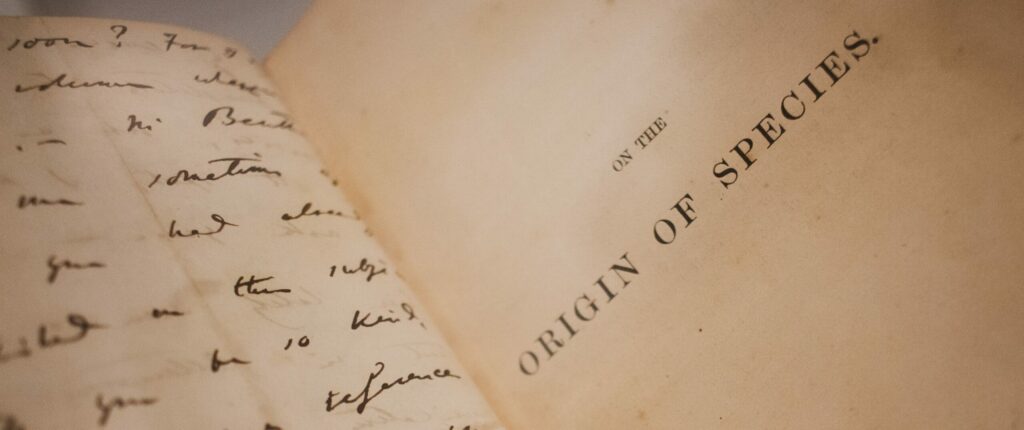
On the Origin of Species 

Soon after his return to England in 1836, Charles Darwin arrived at the principle of ‘natural selection’ as a mechanism for the creation of new species, but for the next 20 years he kept his ideas strictly to himself, Charles Lyell, and Joseph Hooker, while he patiently amassed evidence in their support. On 1 July 1858, in response to a letter from Alfred Russel Wallace who had come up with a virtually identical theory, though with less supporting evidence, the joint Darwin-Wallace papers were presented in outline to the Linnean Society of London. Darwin then settled down to write a fuller account of his theory and On the Origin of Species was released to the booksellers on 24 November 1859.

Although his ideas were soon accepted by the majority of scientists, the challenge that they offered to the Church and to the rest of society took longer to make its mark, but their importance in obliging mankind to take a radically fresh view of itself has long since been universally recognised. 

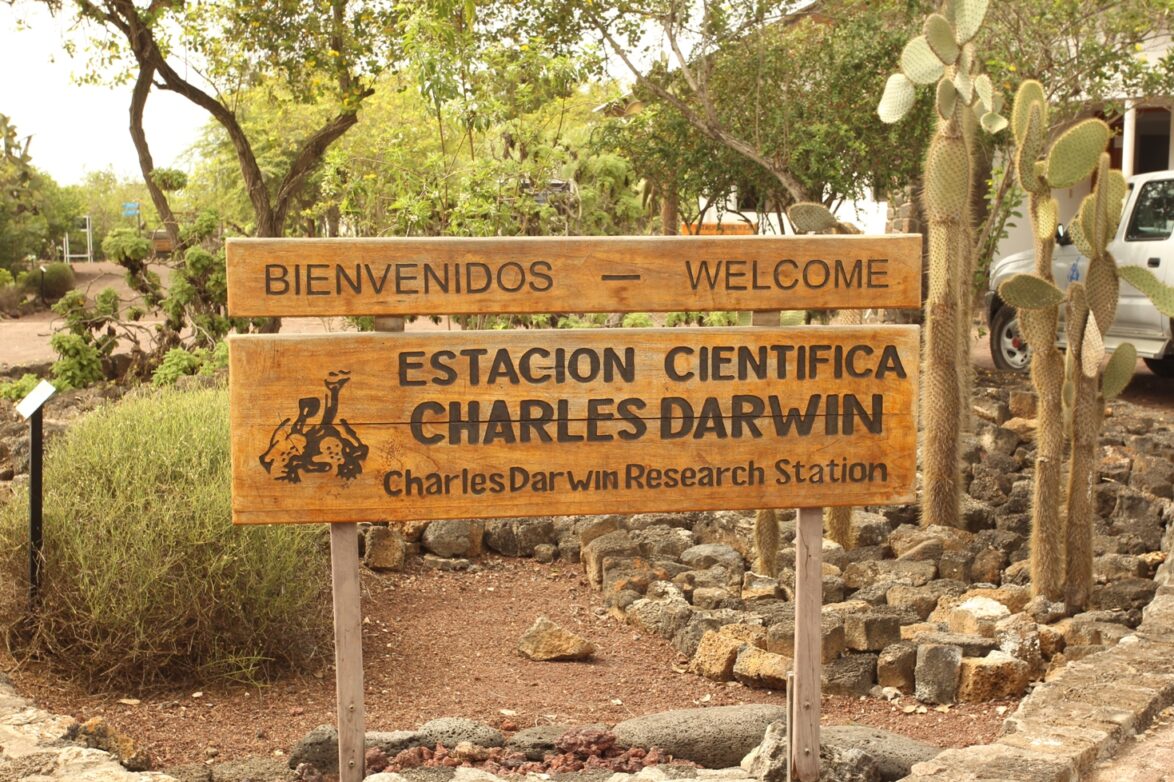
Charles Darwin Research Station, Santa Cruz, Galapagos

Darwin’s voyage on the Beagle 

The events that led to Darwin’s recruitment to sail on HMS Beagle were somewhat bizarre. When in 1830 Captain Robert FitzRoy was commanding the ship on the first of her two survey voyages, he had trouble in Tierra del Fuego because of the tendency of the local people to steal everything on which they could lay their hands. He tried to curb their thieving by taking some hostages, but they preferred retention of their booty to the release of their comrades. He was left with four Fuegians on his hands and conceived of the notion of taking them back to England to be educated, and later returning to Tierra del Fuego to pass on the benefits of civilisation to their people.

The Lords Commissioners of the Admiralty were not very sympathetic to his philanthropic proposals, but eventually succumbed to pressure from his influential relatives and re-appointed him to the command of the ship in 1831 so that he could both complete the survey and repatriate his Fuegians. FitzRoy had recorded in 1830 that if he went out again he would like to have a geologist with him to examine the land while he and his officers looked after the hydrography. He asked his friends at Cambridge University to suggest a suitable person for this post and they came up with the name of Charles Darwin, who had just graduated in theology but was considered to have much promise both in geology and in natural history. After Charles’ father had been persuaded that the trip would not be unsuitable to his chosen profession as a clergyman, he was interviewed by FitzRoy and accepted as his companion to serve as the Beagle’s geologist and naturalist. 

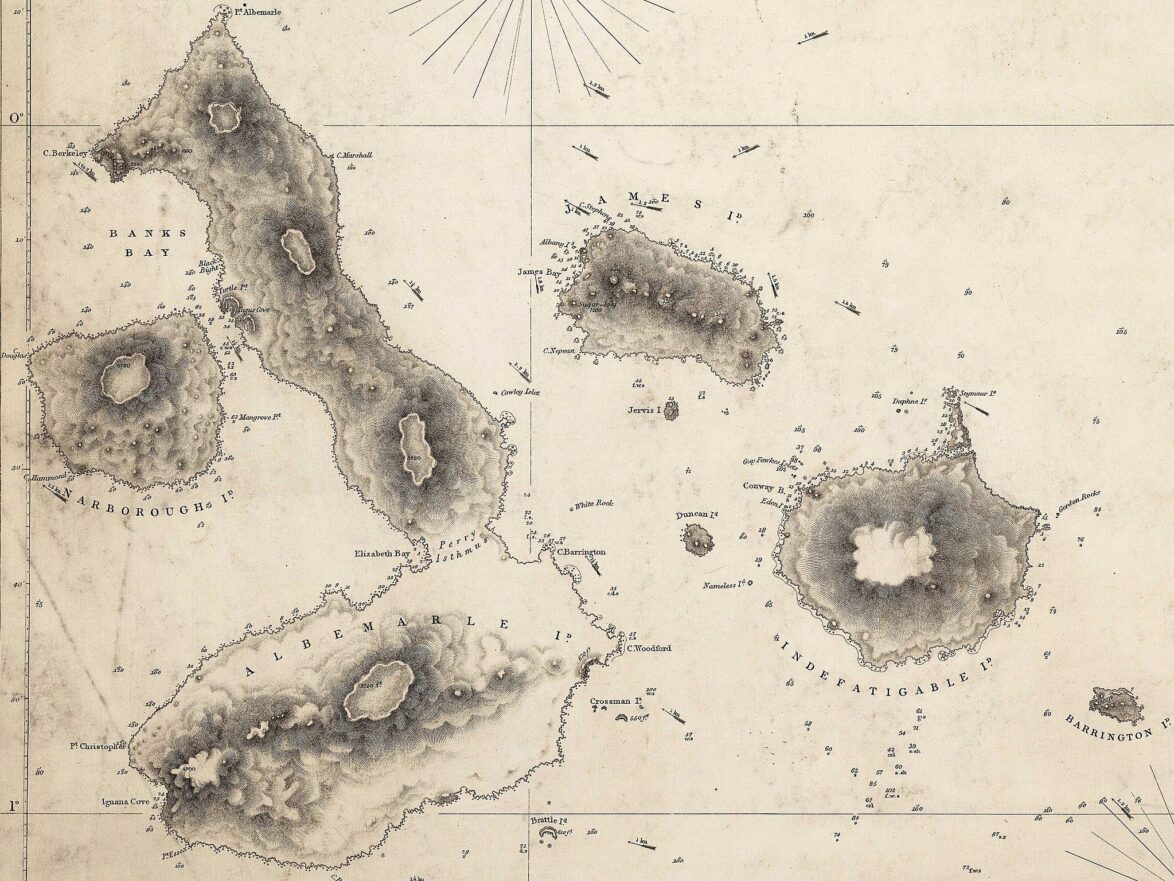
Part of an Admiralty Chart of the Galapagos Islands made by Robert FitzRoy, published 1841
Part of an Admiralty Chart of the Galapagos Islands made by Robert FitzRoy

The role of Galapagos in Darwin’s theory

In the opening sentence of On the Origin of Species, Darwin affirmed that his observations when on board HMS Beagle had played a vital part in the development of his theories. However, the idea that he was struck by a blinding flash of inspiration upon first landing in Galapagos and seeing the finches that came to bear his name is far from the truth.

It is clear from his notes that he continued for some nine months after visiting Galapagos to believe in the fixity of species, and his earliest doubts about the correctness of this doctrine, written around 1 July 1836 on the last leg of the journey, were based on the mockingbirds that he had collected, not the finches. It was only in March 1837 that the penny dropped, when the ornithologist John Gould reported to him that the finches were not, as he had supposed, members of several widely different families, but all belonged to one remarkable new family now known as the Geospizinae. It then became clear that Darwin had mixed up some of his specimens and had not recorded with his usual care exactly where all of them had been collected, so that he was obliged to seek help from those of his shipmates who had also shot some finches.

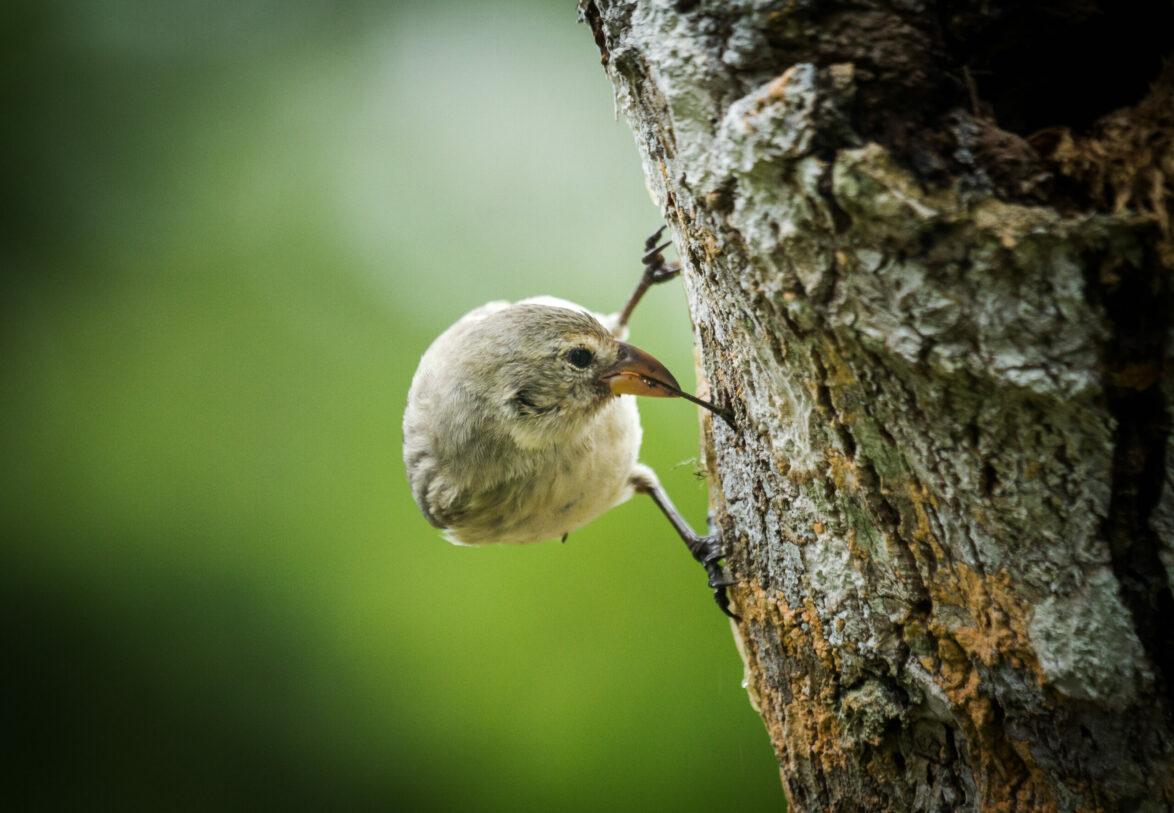
The resulting collection, now lodged at the Natural History Museum in London, has been described as a taxonomist’s nightmare. Nevertheless, the manner in which members of this family of birds had evolved to fill several distinctly different ecological niches has been fully confirmed by later work and recent studies in Galapagos on the beaks of the finches have provided striking new evidence on the operation of natural selection in real time. 

Woodpecker finch in Galapagos
Woodpecker finch © Ian Henderson

Conservation in Galapagos 

The concept of conservation had yet to be born in 1835 and, as has been seen, Charles Darwin behaved as all his predecessors did and departed with a large cargo of tortoises. But within ten years the tortoises were extinct on Floreana Island, partly because of heavy depredations by visiting ships and partly because the tortoises were losing out through competition with the goats that had been introduced and the destruction of their eggs and young by dogs and rats. Darwin would have been the first to appreciate the vital importance of protecting the fauna and flora from feral competitors if the Enchanted Isles were to remain as he found them. 

Discover Darwin

To find out more about Charles Darwin and his theory of evolution, visit our Discovering Galapagos educational website.

Find out more about the history of Galapagos

7 de noviembre de 2025
Historia de Galápagos

La vida de Diego, la tortuga gigante

En junio de 2020, una tortuga gigante muy especial pisó su isla natal de Española tras 86 años de ausencia.
Seguir leyendo
Arid landscape on Fernandina
31st Oct 2025
Botany Historia de Galápagos

Discover Darwin's plants

Open a secondary school biology textbook and you’ll find the Galapagos finches being used to illustrate the process of natural selection. Galapagos plants rarely get a look in, but maybe they should.
Seguir leyendo
Española mockingbird
28th May 2025
Evolución y genética Historia de Galápagos

On the Origin of Natural Selection Webinar 2025

At our webinar on 27 May, Dr Henry Nicholls discussed the importance of Galapagos to Charles Darwin and the impact that his thinking has had on how we see the Islands today.
Seguir leyendo
Eruption on Fernandina island, Galapagos
19 de mayo de 2025
Geología Historia de Galápagos

Historia de Galápagos: La grieta de la fatalidad

Los historiadores desconfían de los relatos de primera mano del explorador Benjamin Morrell, descrito como "el mayor mentiroso del Pacífico". Pero sabemos que fue testigo de una de las erupciones más dramáticas de las Galápagos.
Seguir leyendo

Help us to preserve Darwin’s legacy

Hay muchas formas de apoyar nuestra visión de unas Galápagos sostenibles: ¿por qué no adoptar un animal, hacerse socio del GCT o hacer un donativo hoy mismo?

Reciba las últimas noticias de Galápagos

Suscríbase a nuestra lista de correo para recibir nuestro boletín mensual por correo electrónico, con las últimas noticias sobre Galápagos y nuestro trabajo para proteger las islas.

Este campo está oculto cuando se visualiza el formulario
Compartir esta página